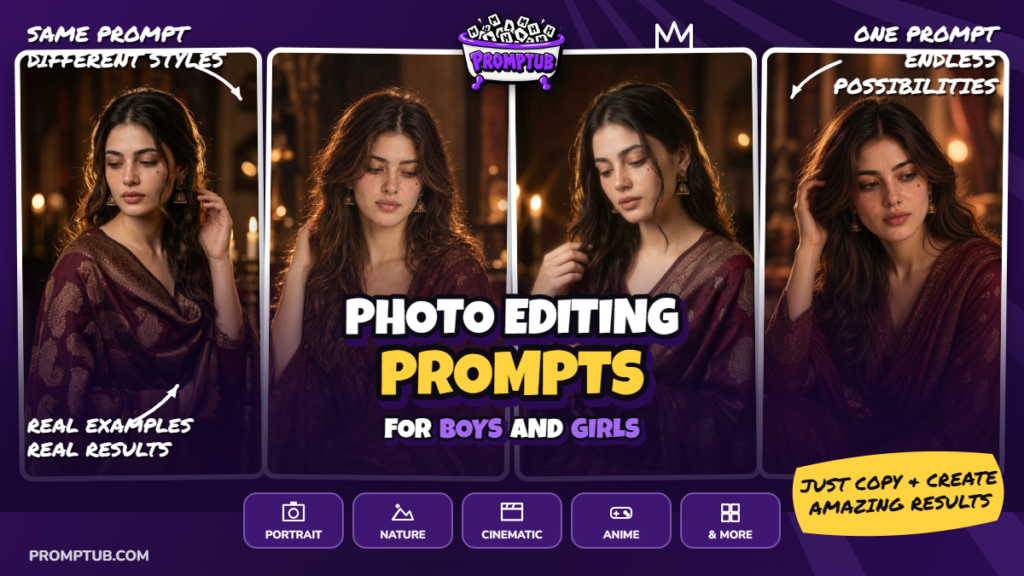
A cinematic Indian portrait in a deep burgundy paisley shawl, lit by a warm golden backlight with dreamy film softness and a blurred heritage interior.
The prompt
13,342 characters
Transform the uploaded reference photo into a highly realistic, cinematic Indian portrait while preserving the identity and natural appearance of the person in the uploaded image.
IMPORTANT IDENTITY RULE:
The uploaded image is the single and only source of truth for the person. Preserve the person's exact facial identity, facial structure, natural skin characteristics, recognizable features, face shape, eyes, nose, lips, eyebrows, jawline, hairline, and overall appearance. Do not replace the face with another person. Do not create a generic model. The final person must clearly remain the same individual from the uploaded image. Preserve natural asymmetry and realistic human details. Do not beautify the face excessively, do not reshape facial features, do not make the person look like a different celebrity or model, and do not artificially perfect the face.
Add dreamy effect as a filter and a very little golden shadow around body area
Create an intimate, elegant, warm, cinematic Indian portrait with the visual mood of a sophisticated evening fashion photograph. The image should feel like a naturally photographed moment rather than an AI-generated fashion image.
OUTFIT:
Dress the person in a luxurious deep burgundy, wine-red, and dark maroon traditional Indian outfit with a rich paisley-inspired woven pattern. The fabric should look soft, expensive, slightly textured, and naturally draped around the body. Use a traditional Indian shawl/dupatta draped gracefully around the shoulders and upper body, with the fabric wrapping naturally across the chest and falling softly toward the sides.
The textile should feature intricate antique-gold and muted bronze paisley, floral, and traditional Indian ornamental motifs. The embroidery and woven patterns should be subtle, sophisticated, and realistic rather than overly bright or heavily embellished. The dominant color should remain deep wine/maroon with understated antique-gold detailing.
The fabric must have realistic folds, natural weight, subtle sheen, and believable textile texture. Avoid plastic-looking fabric. The clothing should look like a premium traditional Indian textile photographed under warm cinematic lighting.
Add elegant traditional Indian jewelry, keeping it tasteful and relatively minimal. Include delicate traditional earrings such as antique-gold jhumka-style earrings and a small elegant traditional nose ring/nath if appropriate for the person's appearance. Jewelry should have realistic metallic reflections and fine craftsmanship without becoming excessively large or distracting.
HAIR:
Keep the person's natural hairstyle recognizable while giving the hair a soft, naturally styled, slightly voluminous appearance. Long, dark, naturally textured hair should gently frame the face and shoulders. Allow a few delicate loose strands of hair to fall naturally around the face. Individual flyaway hairs should be visible, especially where the warm backlight catches them.
POSE AND EXPRESSION:
Create a soft, candid, graceful portrait rather than a stiff studio pose. The person should be positioned slightly turned toward the camera, with the head gently tilted downward or slightly to one side. The eyes should naturally look downward or slightly away from the camera, creating a quiet, intimate and thoughtful expression.
One hand may be naturally raised toward the hair, gently touching or adjusting the hair near the side of the head. The gesture must look spontaneous and anatomically correct, as though captured during a real candid moment.
Keep the expression subtle and elegant: a very soft closed-mouth smile or relaxed natural expression, with calm eyes and a peaceful mood. Do not create an exaggerated smile.
CAMERA AND COMPOSITION:
Create a vertical 9:16 portrait composition designed for Instagram Reels, Stories, and social media posts.
Frame the person from approximately the waist/chest area upward, depending on the original image composition. Keep the face as the primary visual focus while allowing enough of the traditional clothing to remain visible.
Use a realistic professional portrait-camera aesthetic with a shallow depth of field. The face and eyes should be naturally sharp while the background gradually falls into a beautiful soft blur.
Use a cinematic portrait lens look similar to approximately 50mm–85mm full-frame photography, with natural perspective and gentle compression. Avoid extreme wide-angle distortion.
The composition should feel organic and editorial rather than perfectly symmetrical. Leave subtle breathing room around the head and shoulders.
BACKGROUND:
Create a dark, warm, luxurious indoor environment with an intentionally blurred background.
The background should feel like an elegant traditional Indian interior or intimate heritage-style room, but it must remain subtle and out of focus. Use deep brown, burnt umber, dark chocolate, muted terracotta, and warm amber tones.
Include extremely soft, indistinct environmental shapes in the background, such as warm architectural surfaces, curtains, traditional interior textures, or softly illuminated walls. Do not make any background object highly recognizable or distracting.
The background should contain gentle warm pools of light and soft circular bokeh. Keep the environment atmospheric and photographic rather than looking like an obvious digital set.
LIGHTING:
Use dramatic but soft cinematic warm lighting.
Create a strong warm amber/golden rim light from behind and slightly above the person. This backlight should gently illuminate the edges of the hair and create a beautiful glowing halo around the silhouette.
The hair should contain delicate golden highlights and naturally illuminated flyaway strands. The rim light should feel like real warm tungsten or candle-like evening light rather than an artificial neon glow.
Illuminate the face using a very soft warm key light from the front/side. The face should remain clearly visible with natural skin texture while retaining gentle shadows.
Use soft shadow transitions across the face and clothing. Maintain dimensionality and depth without making the image excessively dark.
Add subtle warm atmospheric glow around the brightest areas, especially around the hair and background lights. The glow must remain controlled and photographic.
COLOR GRADING / FILTER:
Apply a sophisticated warm cinematic color grade inspired by vintage Indian evening photography.
Use deep chocolate brown shadows, rich burgundy and wine-red midtones, muted amber highlights, warm skin tones, and subtle golden highlights.
The overall image should have a dark warm brown-and-maroon palette with slightly faded cinematic characteristics.
Preserve natural skin tones while adding a gentle warm glow. Skin should look healthy, realistic, soft, and naturally luminous — never orange or overly smooth.
Use slightly lowered saturation in the background while allowing the burgundy clothing and warm golden highlights to remain rich.
Create gentle highlight roll-off, soft contrast, slightly lifted cinematic blacks, subtle tonal compression, and a delicate film-like softness.
Add extremely subtle photographic grain and organic texture, similar to a high-end cinematic still photograph. The grain should be barely noticeable and should never make the image look noisy.
Use soft halation around strong warm light sources and subtle bloom around the brightest hair highlights, while keeping the face crisp.
The final image should feel like it was captured on a professional cinema camera with a vintage-inspired lens and carefully color-graded afterward.
REALISM:
Prioritize photorealism above everything else. Preserve realistic human anatomy, realistic hands, realistic hair, realistic fabric behavior, realistic jewelry, realistic skin texture, natural shadows, accurate light interaction, and believable depth of field.
The final result should look like a genuine professionally photographed portrait, not an illustration, painting, CGI render, beauty filter, or AI-generated face.
Maintain natural pores and subtle skin texture. Avoid excessive skin smoothing. Keep tiny imperfections that make the person look human.
The final image should have an emotional, intimate, elegant, luxurious, warm, nostalgic, cinematic atmosphere.
HIGH-QUALITY OUTPUT:
Ultra-realistic photography, cinematic portrait photography, realistic skin texture, realistic fabric texture, physically accurate lighting, natural depth of field, subtle film characteristics, detailed hair strands, realistic jewelry reflections, high dynamic range, soft highlight roll-off, professional color grading, refined composition, premium editorial photography, authentic Indian aesthetic, warm evening atmosphere, deep burgundy and antique-gold palette, 9:16 vertical composition.
optical diffusion + soft-focus lens + halation + highlight bloom + atmospheric haze + lifted blacks + light scattering + dreamy film softness
The result must look like a real photograph taken in a beautiful warm Indian interior during the evening, with an elegant traditional outfit, glowing backlight, soft bokeh, rich maroon tones, and a subtle cinematic film filter.
Note: Do not change the person's identity, do not create a different face, do not replace the face, do not make the person look like a celebrity, do not create a generic model, no face morphing, no facial reconstruction, no excessive beautification, no altered facial structure, no changed eye shape, no changed nose, no changed lips, no changed jawline, no changed skin tone, no unrealistic symmetry, no plastic skin, no airbrushed skin, no excessive skin smoothing, no beauty filter, no doll-like face, no porcelain skin, no cartoon appearance, no anime, no illustration, no painting, no CGI, no 3D render, no artificial-looking portrait, no unrealistic eyes, no deformed eyes, no crossed eyes, no distorted pupils, no extra eyes, no asymmetrical facial distortion, no deformed nose, no distorted mouth, no unnatural smile, no exaggerated expression.
No distorted hands, no extra fingers, no missing fingers, no fused fingers, no malformed hands, no unnatural wrist position, no broken anatomy, no extra limbs, no duplicate body parts.
No modern western clothing, no casual clothing, no jeans, no T-shirt, no synthetic-looking clothing, no plastic fabric, no overly shiny fabric, no neon colors, no bright red clothing, no bright yellow clothing, no excessive embroidery, no excessive glitter, no costume-like appearance, no fantasy clothing.
No oversized jewelry, no exaggerated jewelry, no fake-looking gold, no excessive gemstones, no distracting accessories.
No harsh flash, no studio flash look, no cold blue lighting, no white fluorescent lighting, no neon lighting, no flat lighting, no overexposure, no crushed blacks, no extreme HDR, no excessive bloom, no excessive glow, no artificial halo, no strong lens flare.
No overly orange skin, no yellow skin, no gray skin, no unnatural skin colors.
No sharp or detailed background, no busy background, no modern city background, no obvious studio backdrop, no artificial scenery, no distracting objects, no readable text, no signs, no logos, no watermark.
No excessive bokeh, no fake bokeh, no unrealistic light circles, no excessive blur on the subject, no blurry face, no soft-focus face, no loss of facial detail.
No excessive grain, no heavy noise, no vintage damage, no scratches, no dust, no film burns, no extreme retro effect.
No oversaturation, no excessive contrast, no crushed shadows, no blown highlights, no unnatural color grading, no teal-and-orange Hollywood grade, no excessive vignette.
Do not make the image look AI-generated. Do not over-process the image. Do not over-sharpen. Do not make the person look younger or older than the reference. Do not alter body proportions unnecessarily. Preserve realistic anatomy and natural proportions.
Do not remove the dreamy effect, do not make the image clinically sharp, do not make it look digitally processed, do not use excessive clarity, excessive sharpness, hard micro-contrast, HDR look, harsh digital edges, overly crisp skin, modern smartphone processing, excessive detail enhancement, or clinical studio photography.
Do not create ordinary blur, Gaussian blur, motion blur, defocus blur, or an out-of-focus subject.
The dreamy softness must be optical and atmospheric, with the face remaining recognizable and naturally detailed.
Do not make the glow look like a Snapchat filter, Instagram filter, beauty filter, neon glow, fantasy aura, or artificial light effect.
No excessive bloom, no excessive haze, no thick fog, no white veil over the image, no milky washed-out appearance, no excessive exposure, no glowing skin effect, no plastic skin.
Do not make the entire image equally soft. Keep the face and important subject details naturally defined while allowing the highlights, hair edges, background, and shadows to have a soft dreamy diffusion.
No cold tones, no blue cinematic grade, no teal-orange grade, no overly saturated colors, no excessive contrast.
Keep the final result elegant, subtle, realistic, cinematic, warm, intimate, premium, and photographic.