Home ›
Turn your normal image into navratri selfie photo
Turn your normal image into navratri selfie photo
ChatGPTGeminiGrokUpdated 2026-10-09
A mid-dance garba selfie under string lights, with mirror-work chaniya choli and your own face kept.
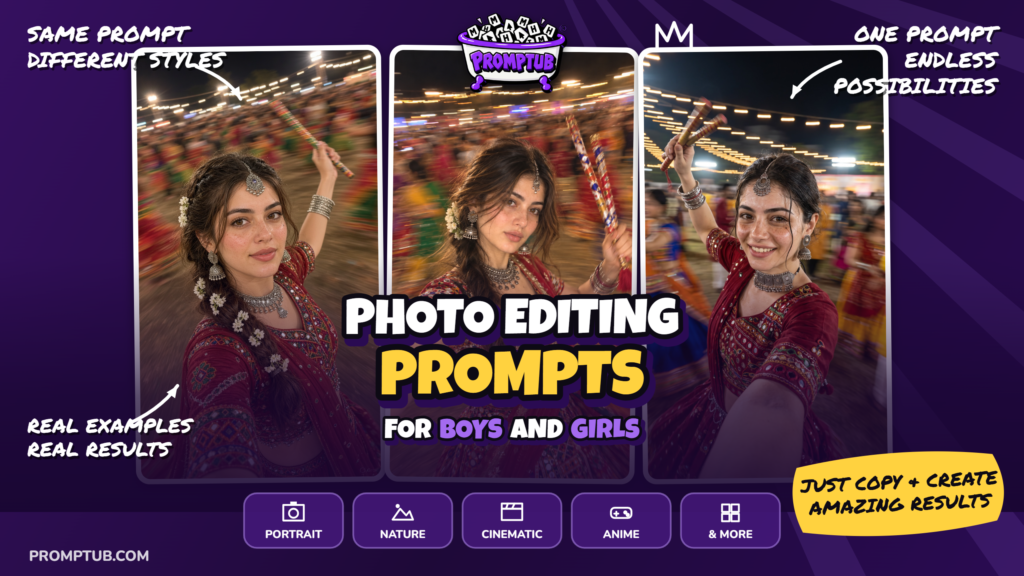
Example output — this is what the prompt produced. 16:9 aspect ratio.
More results from this prompt
ChatGPT result
Gemini result
Grok result
Bring the excitement of a garba night into your photo with this Navratri selfie prompt. It creates a cheerful moment where you are smiling at the camera, holding dandiya sticks and turning with the dance. The colorful crowd behind you appears in motion, while your face remains clear.
The look includes a deep-red chaniya choli decorated with mirror work and colorful embroidery. A matching dupatta, silver jewelry and small white flowers in the hair complete the festive outfit. The red clothing gives the picture a lively appearance, while the little mirrors catch the lights hanging above the ground.
This photo is meant to feel like a selfie taken while enjoying the celebration. The camera is close to the face, the shoulders are slightly turned and the smile is relaxed. It captures the feeling of being in the middle of the music and dancing, rather than standing still for a formal portrait.
Warm lights and a dark evening sky give the background a Navratri-night atmosphere. Other dancers fill the ground, but their faces are not clearly visible. Their colorful clothes blend into the movement behind you, making your smile and traditional outfit stand out.
If you want a festive photo with more energy than a regular selfie, this is a lovely idea to try. It can suit a Navratri post, an Instagram Story or a WhatsApp Status. The dandiya sticks and chaniya choli make the theme easy to recognize.
To create your version, upload a clear photograph of yourself and paste the complete prompt below into your AI image tool. The prompt asks it to keep your recognizable face while creating the outfit and garba setting. You can explore the look without needing a photo taken at an actual dance ground.
The prompt4,307 characters
Use the uploaded photo as the only source of the person's identity. Keep the face
exactly as it is: the same bone structure, proportions, natural asymmetry, eyes,
nose, lips, jawline, skin tone and hairline. Do not beautify, slim, smooth,
symmetrise or reshape anything. Do not swap in a different face.
SHOT
An adult at a Navratri garba night, holding the phone out at arm's length and
taking a selfie mid-dance, dandiya sticks in the raised hand, with the whole
ground spinning behind her.
FRAMING
Vertical 9:16, shot on a phone's wide front camera at arm's length, so the face
is close and large in the upper half of the frame and the perspective stretches
slightly at the edges the way a wide lens does. The raised arm enters the frame
from one side. The bottom of the frame shows the chaniya choli from the waist up.
Behind her, a wide open ground full of other dancers. The camera is held slightly
above eye level and tilted a little, not level.
SUBJECT DETAIL
She is mid-turn, shoulders angled away, face coming back to the camera with an
open, unforced smile. One hand is raised holding a pair of painted dandiya sticks.
A traditional chaniya choli in deep red with dense mirror work and geometric
embroidery in green, orange, blue and white, the choli high-necked and properly
fitted, the dupatta draped across the chest and over one shoulder in the usual
way. Oxidised silver jewellery: a layered choker with small bell drops, large
jhumka earrings, a maang tikka in the hair parting, and a stack of thin silver
bangles on the raised wrist. A string of small white flowers pinned into the hair.
Hair in a loose braid with strands escaping from the dancing.
MOVEMENT
The background is heavily motion blurred. The dancers behind her are pulled into
long horizontal smears of red, orange, green and yellow, their shapes dissolved
by the turn, with no individual face readable anywhere in the crowd. The strings
of bulbs overhead are stretched into short streaks of warm light rather than round
points. The ground beneath them is smeared in the same direction.
Her own face stays completely sharp, because the phone is held in her hand and
travels with her head as she turns — the two move together while everything
around them does not. Her raised hand, the dandiya sticks and the loose end of
the dupatta carry a lighter blur, since they are moving faster than her head.
SKIN AND HAIR
Skin as it looks from a few feet away: normal colour variation, neither smoothed
nor sharpened. Do not emphasise pores. A natural warmth across the cheeks from
dancing. Loose hair strands stuck to the temple, and the ends of the braid blurred
by the movement.
LIGHT
Strings of small warm bulbs hung overhead across the ground are the main source,
so the light falls from above and slightly behind, catching the top of the hair,
the mirrors on the choli and the silver jewellery as small bright points. The open
ground and the pale dust bounce a little of it back so the face stays clearly lit
rather than shadowed. Beyond the lights the sky is fully dark.
CAMERA AND RENDERING
Phone front camera, wide lens, shot at a slow shutter so the movement registers.
The face is sharp; everything behind it is smeared. Ordinary high-ISO noise in the
darker parts. Warm colour, honest exposure, nothing graded.
MOOD
In the middle of it, not posing for it.
NEGATIVE
No enlarged or brightened eyes, no added eyeliner, no changed eye colour, no
doll-like face, no waxy or plastic skin, no artificial symmetry, no reshaped nose
or lips, no whitened teeth. The choli is worn traditionally and fits properly —
no lowered or altered neckline, nothing revealing, no exposed midriff beyond the
normal cut of the garment. The face must not be blurred. No radial or zoom blur,
no spiral swirl, no filter-style blur applied over the whole picture — the blur
comes only from things actually moving. No studio lighting, no flash, no rim
light. No star sparkles drawn on, no glow, no lens flare added.
Render this as an ordinary photograph rather than a showcase one. No HDR, no heavy
colour grade, no vignette, no over-sharpening, no glossy skin, no exaggerated
contrast.
OUTPUT
Photorealistic, natural detail, fine grain, 9:16, high resolution.
The movement is what makes this garba selfie different. Your face stays visible while the crowd and lights behind you show the energy of the dance. It gives the picture the feeling of a quick, happy moment caught during the evening.
The red chaniya choli adds plenty of color on its own. Green, orange, blue and white embroidery brings extra detail, while the mirror work gives the outfit a festive finish. The silver choker, jhumkas and bangles fit naturally with the clothing and dandiya sticks.
Small touches make the scene feel personal. Loose strands of hair, flowers pinned into the braid and a dupatta moving with the turn all suggest that you are enjoying the dance. The expression is friendly and open, giving the portrait a joyful mood.
This style is a good choice if you prefer celebration photos that feel active and casual. It shows the outfit, but it also tells a little story: you are on the ground, surrounded by dancers, taking a selfie before joining the next turn.
The tall picture format leaves space for your face, raised hand and some of the chaniya choli. That makes it useful for a phone screen or Story, where the whole festive scene can stay visible. You can also keep it in a collection of traditional portraits made from your own photo.
Using your photograph makes the idea more meaningful. The aim is to see yourself in the celebration, with your natural features and a new festive look. Results can vary, so choose the version that you feel represents you best.
The finished picture is an AI-created Navratri portrait. It offers an easy way to enjoy a garba-inspired photo, whether you are preparing for the festival or simply love the colors, outfits and cheerful atmosphere of the celebration.